

The structural integrity of Philadelphia’s historic neighborhoods relies upon a subterranean network of rare complexity, where sewer lateral responsibility in Philadelphia defines the legal and technical boundary between private property and municipal authority. For the owner of a century-old row home, understanding this limit is crucial, as it determines the financial burden of repairs during a structural failure. Generally, the homeowner’s responsibility extends from the building’s foundation to the physical connection with the City’s main sewer, often including the portion located beneath the sidewalk and, in many instances, extending under the street to the “Y” or “T” branch connection.
1. The Geology of Infrastructure: A Legacy of Cast Iron and Clay
The Philadelphia metropolis presents a unique engineering challenge due to the diversity of its historic materials. Lateral conduits, strictly governed by sewer lateral responsibility in Philadelphia, are primarily composed of two materials whose chemical degradation is inevitable:
- Grey Cast Iron (The Graphitization Risk): Massively utilized until the 1960s, this material undergoes a process known as graphitization. The iron matrix dissolves via electrochemical corrosion, leaving behind a porous graphite structure that retains the pipe’s appearance but loses all compressive strength.
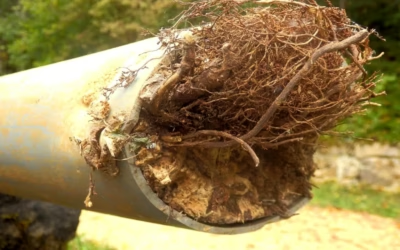
- Vitrified Clay Pipe (The Shear Force Vulnerability): While chemically inert, it is vulnerable to shear forces caused by the differential settlement of the Delaware Valley’s clay-heavy soils. The porosity of the joints attracts root systems, whose osmotic pressure eventually fractures the material.
Furthermore, the Pennsylvania climate imposes severe freeze-thaw cycles. The crystallization of water within soil pores increases volume by 9%, exerting colossal lateral pressures on infrastructures already weakened by time.
2. Technical Demarcation: The Philadelphia Water Department (PWD) Standards
According to recent directives from the Philadelphia Water Department (PWD), the demarcation of sewer lateral responsibility in Philadelphia is unambiguous: the owner is responsible for the maintenance and repair of the lateral drainage pipe, as well as the water service line, from the property to the City sewer.
The Specificity of the Curb Line
While many believe the “curb” is the final point of responsibility, the PWD often enforces the “full lateral” rule. If a blockage occurs 15 feet into the street but within your specific lateral line, it remains the homeowner’s burden. This is why a professional SEWER CAMERA INSPECTION & DIAGNOSTICS is non-negotiable. Without visual evidence, you may end up paying for excavations that were actually the City’s responsibility—or vice versa.
3. The Physics of Rehabilitation: The Science of CIPP and High-Pressure Dynamics
When responsibility is established, modern rehabilitation prioritizes Cured-In-Place Pipe (CIPP) technology. This process relies on a controlled exothermic reaction:
- Impregnation: A polyester felt liner is saturated with an epoxy or vinylester resin.
- Inversion: Le liner est introduit dans la conduite via la pression hydrostatique.
- Polymérisation: L’introduction de chaleur déclenche la réaction chimique.
Before any lining can occur, the host pipe must be cleared of mineral deposits and scale. Our PIPE LINING & DESCALING service utilizes mechanical cutters to restore the internal diameter. For softer blockages or grease accumulation, we deploy [[HYDRO-JETTING]] at pressures exceeding 4,000 PSI. This hydraulic force shears away biofilms that lead to the collapse of older lateral lines. If the damage is localized under the street, a [[SEWER LINE REPAIR & REPLACEMENT]] may be the only permanent engineering solution.
4. Why This Matters for Philadelphia Row Homes
In neighborhoods like South Philly or Fishtown, row homes share narrow corridors. A failure in one lateral can undermine the soil stability of an entire block.
- Soil Erosion: A leaking sewer lateral creates “voids” under the sidewalk.
- Structural Subsidence: Once the soil is washed away, the concrete sidewalk can collapse.
- The Solution: Proactive maintenance through MAIN LINE CLEANING & EXTERIOR DRAIN CLEARING is the only way to avoid the five-figure costs of emergency street excavation. For issues that start inside the home, our KITCHEN, TOILETS & INDOOR DRAIN UNCLOGGING ensures the entire system remains functional.
Further Reading : Sewer Line Maintenance in Greater Philadelphia: The Complete Guide
5. Conclusion and Regulatory Compliance
Wastewater management in Philadelphia tolerates no approximation. Between EPA mandates regarding the reduction of Combined Sewer Overflows (CSO) and ASCE standards for infrastructure life cycles, the homeowner must act preventatively. For any uncertainty, it is imperative to consult an expert for a precise technical diagnosis. Our team also provides STORM DRAIN & YARD DRAIN CLEANING for comprehensive water management. Finally, always verify the source of the problem before digging; a [[FREE SECOND OPINION ON REPAIRS]] could save you from unnecessary municipal-scale expenses.