

Sewer line maintenance in Greater Philadelphia is far more than a routine chore to be checked off a list. It is, in fact, the ultimate defense against the unique infrastructural challenges of our historic region. From the aging terra cotta pipes of South Philly to the root-invaded systems of the suburbs, maintaining your main sewer line is the only way to prevent catastrophic backups and the punishing expense of emergency excavations. Ultimately, a deep understanding of your network and the methods used to prevent anomalies is your best guarantee against finding yourself knee-deep in sewage with a repair bill that threatens to ruin you.
Why Philadelphia’s Infrastructure Demands Special Care
Philadelphia—and its immediate surroundings—is one of the oldest inhabited regions in the country. Its underground network reflects a history that it has not only shaped but also endured. Many properties still rely on combined sewer systems or aging cast iron and terra cotta pipes that are prone to cracking, shifting, and “bellies” (low spots where waste accumulates). Time, as they say, spares nothing.
These factors make a profound understanding of Sewer line maintenance in Greater Philadelphia, as well as the mastery of specific soil conditions and historic materials, an absolute necessity. For instance, without regular inspection, a simple hairline crack can rapidly escalate into a total collapse under the pressure of Pennsylvania’s intense freeze-thaw cycles. Furthermore, our historic row homes often share complex lateral connections that demand a high level of expertise for optimal maintenance. In this guide, we will explore how to keep your lines intact while maintaining a manageable budget.
A Comprehensive Approach: The Pillars of Structural Health
To preserve the integrity of an underground network in a region as complex as the Delaware Valley, maintenance cannot be merely reactive; it must rely on a rigorous methodology. This approach rests on three interdependent stages that transform a vulnerable infrastructure into a sustainable system.
Further Reading : Main Line Sewer Backup Signs: The Silent Flood Threatening Your Greater Philadelphia Home
Diagnosis Through Imaging: The End of Uncertainty
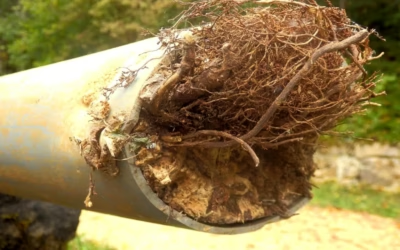
Before any physical intervention, the priority is to achieve total visibility. The use of high-definition waterproof cameras allows us to explore the depths of the network to identify pathologies that are often invisible from the surface. In historic neighborhoods like Chestnut Hill or the dense sectors of the city, this digital gaze reveals the true causes of drainage failure: stubborn tree root infiltration, the slow but inevitable corrosion of ancient cast iron, or structural offsets caused by urban vibrations and shifting ground. This diagnostic phase ensures a targeted intervention that respects the existing structure.
Restoring Flow: Professional Hydro-Jetting

When an inspection reveals an obstruction or sediment buildup, the cleaning method must be both radical and respectful of the materials. Unlike mechanical snaking, which often only punches a temporary hole through a clog, hydro-jetting utilizes high-pressure water (up to 4,000 PSI) to fully scrub the internal walls. This process eliminates decades of crystallized grease, scale, and debris. It is the preferred practice for Sewer line maintenance in Greater Philadelphia because it restores the pipes to their original flow capacity without traumatizing them with corrosive chemicals.
Managing Organic Intrusions: Prevention and Treatment
The final pillar involves the struggle against the silent force of nature. Once a root has penetrated a crack, simple mechanical removal is insufficient, as the root will inevitably grow back with even greater vigor. Best practices for maintenance, therefore, include the application of specific growth inhibitors. These solutions target the root tissues inside the pipe without harming the health of the tree above, creating a protective barrier that extends the life of the lateral line for years.
Modern Rehabilitation: The Trenchless Alternative

When routine maintenance reveals structural failures that are too advanced for simple cleaning, trenchless technology emerges as the solution of the future. Rather than turning a Philly garden or sidewalk into a trench, methods such as CIPP (Cured-in-Place Pipe) lining allow us to mold a new resin pipe inside the old one. For more severe breaks, Pipe Bursting allows for the replacement of the line by shattering the old pipe from the inside. These techniques minimize the impact on the immediate environment while providing a durability that is often superior to the original materials.
Further Reading : Understanding Main Sewer Line Maintenance in Greater Philadelphia
Tailoring Maintenance to Property Type
The frequency and nature of maintenance must be adapted to the specific use of the property:
- Residential Sector: The focus here is on sanitary protection and the prevention of domestic backups. A preventive inspection every two years is generally sufficient to anticipate structural disorders.
- Commercial Sector: For restaurants or industrial sites, the load of sediment and grease is ten-fold. A quarterly or semi-annual maintenance schedule is not a luxury, but an operational necessity to avoid business-paralyzing shutdowns.
What to Do in Case of Warning Signs?
Despite regular maintenance, certain signals do not lie and require immediate attention to avoid a major disaster:
- A Chain Reaction of Drains: If your toilets, shower, and sinks all show simultaneous drainage sluggishness, the blockage is in the main line, not your local traps.
- Persistent Odors: The smell of rotten eggs often signals a breach in the system’s seal or the drying out of protective traps.
- Terrain Anomalies: An unnaturally lush patch of grass or a sudden depression in the soil above the sewer line indicates a constant underground leak.
- Auditory Manifestations: Gurgling sounds or air bubbles rising during drainage are precursors to a system under extreme pressure.
Sewer line maintenance in Greater Philadelphia works best when you are proactive. Investing in a precise knowledge of your infrastructure and acting at the first sign of symptoms remains the only viable strategy to preserve your property and avoid disproportionate restoration costs—a process you can start today when you Contact Insta Drain & Sewer for a professional assessment.