

The Time Bomb Beneath Your Feet
Main line sewer backup signs are often hidden beneath the surface of the Greater Philadelphia area. In one of the oldest developed regions in the United States, we live atop an invisible history. Beneath our cobblestone streets, South Philly row homes, and the sprawling suburbs of the Delaware Valley, thousands of miles of pipes—thousands of miles, to be honest!—made of century-old cast iron or terra cotta, perform a thankless task: moving astronomical volumes of wastewater every single day.
Most of the time, this happens in total silence. But in our region, where the infrastructure is as historic as the Declaration of Independence, ruptures occur, demanding interventions that simply cannot be put off until tomorrow. This is where prevention becomes your most valuable asset. For a homeowner in the Greater Philadelphia area, ignoring what lies beneath the basement is a dangerous gamble. A sewer backup is more than just a nuisance; it is a financial and sanitary trauma. Yet, for those who know how to listen, the Main Line often screams before it finally gives way.
Here is how to decode its final warnings.
Need an immediate diagnostic? Explore our Greater Philly Emergency & Diagnostic Services.
1. The Sinister “Gurgling”: When Your Pipes Try to Speak
A comfortable home is a quiet one, a sanctuary where you can rest or sleep without unwanted noise. But a house also has its own “soul”—though perhaps that’s saying too much!—and its own way of telling you when it’s hurting. It won’t cry out like a dog suffering from chronic constipation or a cat that hasn’t been fed in hours…
Imagine this: you’re lying down in your home, and suddenly, a gargling sound erupts from the shower even though no one is using it. Don’t panic; it’s probably not a ghost taking a late-night scrub! Or perhaps you flush the toilet, and your kitchen sink seems to “catch its breath,” much like a soldier who has just finished an exhausting battle.
This phenomenon, which pros call gurgling, is pure physics. When a blockage (grease, roots, or wipes) obstructs the main line, air can no longer flow freely. It searches for an escape and takes the path of least resistance: your drains. It’s as simple as that! But make no mistake: these sounds aren’t just a quirk of your home’s personality. They are signs of a system that is suffocating—a true SOS.
2. The Cross-Backup Paradox (The Domino Effect)

Noises and sounds aren’t the only way your home screams “Help!” There is also what specialists call Cross-Backups.
To understand this phenomenon, let’s look at a concrete example: you see soapy water rising in your ground-floor bathtub, even though that same water is being produced by your washing machine in the basement. It goes without saying that if your bathroom sink is clogged, that’s a local plumbing nuisance. But if—as described—using the laundry causes a backup in the tub upstairs, you are, without a doubt, facing a Sewer Main Line issue.
In the dense neighborhoods of South Philly, Upper Darby, or North Philly, these lines have been pushed to their limits for decades. It helps to visualize your plumbing like a tree: if the trunk (the Main Line) is blocked, the water will inevitably back up into every branch (your sinks, showers, and toilets). Suddenly, those seemingly “illogical” backups make perfect sense. It also explains why so many people in the Greater Philadelphia area spend hours struggling with a plunger, only to fail because the real problem is 50 feet away, beneath the sidewalk, right where the private line meets the Philadelphia Water Department (PWD) or your local municipal domain.
3. Using Your Senses: The Scent of Decay
A healthy home is like a healthy body: it shouldn’t smell like a sewer any more than a healthy body should smell of gangrene. Never! Your drains are designed to hold a small volume of water that acts as a seal against gases. If a smell of rotten eggs or persistent mildew invades your basement or yard, it is, without a doubt, the sign of a breached seal.
Further Reading: Understanding Main Sewer Line Maintenance in Greater Philadelphia
In the Greater Philadelphia area, the ground is in constant motion. Our harsh winters and humid summers cause the earth to heave and shift relentlessly. A century-old terra cotta pipe can easily crack under this pressure, letting gases escape long before any water begins to back up. Some homeowners, often out of laziness or the fear of an unplanned expense, try to convince themselves it’s just a “musty basement” smell. But remember: sewer gas is heavy, chemical, and often unbearable. It is a distress signal for your health as much as for your wallet.
4. The Mystery of Fluctuating Water Levels

Now, let’s look at the most subtle sign: fluctuating water levels. This is a detail that only an attentive homeowner will notice. One morning, the water in your toilet is abnormally low; the next day, after a typical Pennsylvania rainstorm, it seems ready to overflow even though you haven’t touched it.
This instability is the sign of a failing “respiration” in your system. The likely cause: a partial blockage acting like a flap, letting some water through but holding the rest back. In the Greater Philadelphia region, our systems are often “combined” (sewage and rainwater). A fluctuation in the bowl after a storm is the #1 indicator that your main line is saturated. It can no longer handle the flow. A professional video camera inspection is indispensable here to locate the obstruction before the flood begins.
5. The Garden of the Apocalypse: Suspect Greenery
Finally, look outside. Look at your yard—that little island of greenery you cherish so much! It may be hard to believe, but that spot where you host your summer BBQs can tell you everything about your sewer line. If you see a patch of grass that is abnormally tall or suspiciously lush, take a moment to think clearly: that patch might be feeding off your sewer line.
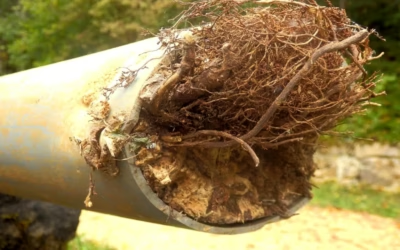
Wastewater is a powerful fertilizer (nitrogen, phosphorus). If your pipe leaks underground, the roots of our neighborhood trees (those magnificent Maples and Sycamores that line our Greater Philadelphia streets) will literally “smell” the nutrients and pierce the pipe to feed. According to the Arbor Day Foundation, tree roots are incredibly persistent when searching for moisture. They turn your pipe into a “straw” for the tree. At this stage, a total collapse is only a matter of time.
Conclusion: Don’t Let the Silence Fool You
In the Greater Philadelphia area, waiting until a problem becomes visible is often waiting too long. Our historic infrastructure doesn’t fix itself. If you recognize any of these 5 signs, prevention is your only ally.
Contact our Greater Philadelphia experts today for a Main Line evaluation and protect the history—and the basement—of your home.